Satellite Spotting for Beginners: How to Identify What You Just Saw
A light crosses the sky, steady and silent, and it is gone within minutes. No blinking, no engine noise, no trailing streak. That is almost always a satellite, and usually one you can put a name to. The trick is not memorising the whole sky. It is knowing what to check: the time, the direction it travels, how bright it gets and whether that brightness holds steady. Do that and you can separate the International Space Station from a fresh train of Starlink satellites from a brief, brilliant flare without much practice at all.
What a satellite actually looks like
From the ground, an object in low Earth orbit is a point of light no bigger than a star. It has no shape, no colour detail and no sound. What gives it away is movement: it drifts steadily against the background of fixed stars, and a typical pass takes a few minutes from horizon to horizon.
Before you assume satellite, rule out the three usual impostors.
- Aircraft. Blinking strobes, red and green navigation lights, and often a faint engine drone. Satellites never blink on a regular cycle.
- Meteors. A fast streak, gone in a second or two, sometimes with a bright head and a fading tail. Satellites are far slower and do not leave trails.
- Stars and planets. Venus and Jupiter can outshine everything else in the sky, but they hold their position relative to the other stars and never cross the sky in minutes.
One exception is worth knowing: a tumbling satellite or a spent rocket body can flash periodically as it rotates, which looks oddly like a slow aircraft. If the flashes are irregular and there is no sound, you are almost certainly looking at hardware.
The ISS: steady, bright, unmistakable
A good pass of the International Space Station is the easiest identification in amateur skywatching. It is a single steady point of light, usually white with a slight golden or cream tint, and on a high pass it can outshine every star and planet except the Moon. Nothing about it flickers.
Two features confirm it. First, the arc: it rises from one direction, climbs across the sky and sets on the other side, all in a smooth sweep of a few minutes. Second, the fade. If the ISS enters Earth's shadow partway across, it will dim and vanish while still well above the horizon. A light that disappears mid-sky has not crashed; it has simply run out of sunlight.
Occasionally you will see two dots travelling in close formation. That is likely the station plus a docked or nearby visiting vehicle, such as a crew or cargo craft, tracking along the same path.
Satellite trains: the string of pearls
Starlink and similar constellations launch in batches, and for the first days or weeks after launch the satellites stay close together. Seen from the ground they form a line of evenly spaced dots moving in the same direction at the same speed, often described as a string of pearls. They are usually fainter than a decent ISS pass, so a dark sky helps.
What separates a train from other satellites is the pattern: multiple lights, identical spacing, no relative movement between them. As the weeks pass, the satellites raise their orbits and spread out, and the train dissolves. If you see one, you are watching hardware that launched very recently.
Flares: short, sharp and bright
A flare is a sudden brightening caused by a flat, reflective surface catching the Sun at exactly the right angle. The classic example was the original Iridium constellation, whose antenna panels produced predictable flares bright enough to be seen from a lit street. Those satellites have been retired, so the famous scheduled flares are largely a thing of the past, but other spacecraft still flare unexpectedly.
The signature is unmistakable once you have seen it. The object is faint or invisible, brightens rapidly over a few seconds, peaks — sometimes brighter than any star — then fades just as quickly. If the brightness shoots up and drops away while the object barely moves, you have caught a flare.
Why timing decides everything
A satellite is only visible when it is lit by the Sun and the ground below it is dark. That happens in a narrow window: roughly an hour or two after sunset, and again before sunrise. By late evening, most low-orbit satellites have slipped into Earth's shadow and simply are not there to be seen. A bright light crossing high overhead at one in the morning is worth a second look.
Direction matters too. Most satellites travel broadly west to east, because launching that way borrows speed from Earth's rotation. The ISS orbits at an inclination of about 51.6 degrees, so it can appear from an unexpected direction, but it will always be moving in that general west-to-east sense. The height of the pass also matters: a pass that only reaches 20 degrees above the horizon is dim and brief, while one climbing past 60 degrees will be bright and slow.
Tools that do the arithmetic for you
You do not need to calculate orbits. Several free services give ten-day predictions for your exact location, including direction, time, peak elevation and expected brightness.
- Heavens-Above — the long-standing reference for predicted passes, with maps and brightness estimates.
- N2YO — live tracking and pass lists for a huge catalogue of objects.
- ISS Detector and similar apps — alerts for the station, bright satellites and flares, with compass guidance.
- NASA's Spot the Station — email or text alerts for ISS passes over your area.
Predictions use the magnitude scale, where lower numbers are brighter and negative numbers mean brighter than the brightest stars. Treat them as a guide rather than a promise: a satellite's apparent brightness changes with its orientation, so a predicted faint pass can surprise you.
Your first clear night: a ten-minute routine
Keep it simple and you will learn faster than you expect.
- Check sunset and pick a window in the first hour or two of darkness. Twilight passes are usually the best ones.
- Look up the pass list for your town and note the time, the direction of appearance and the peak elevation.
- Find a spot away from streetlights, give your eyes ten to fifteen minutes to adapt, and keep your phone screen dim.
- Watch the predicted point on the horizon, then follow the object rather than trying to spot it overhead.
- Note whether it fades before reaching the far horizon, and roughly where. That single detail tells you a lot.
Do this a few evenings in a row and the sky stops being a jumble of moving lights. You will start recognising the station by its unhurried brightness, spotting trains while they are still freshly launched, and catching the odd sudden flare that lasts barely long enough to point at.
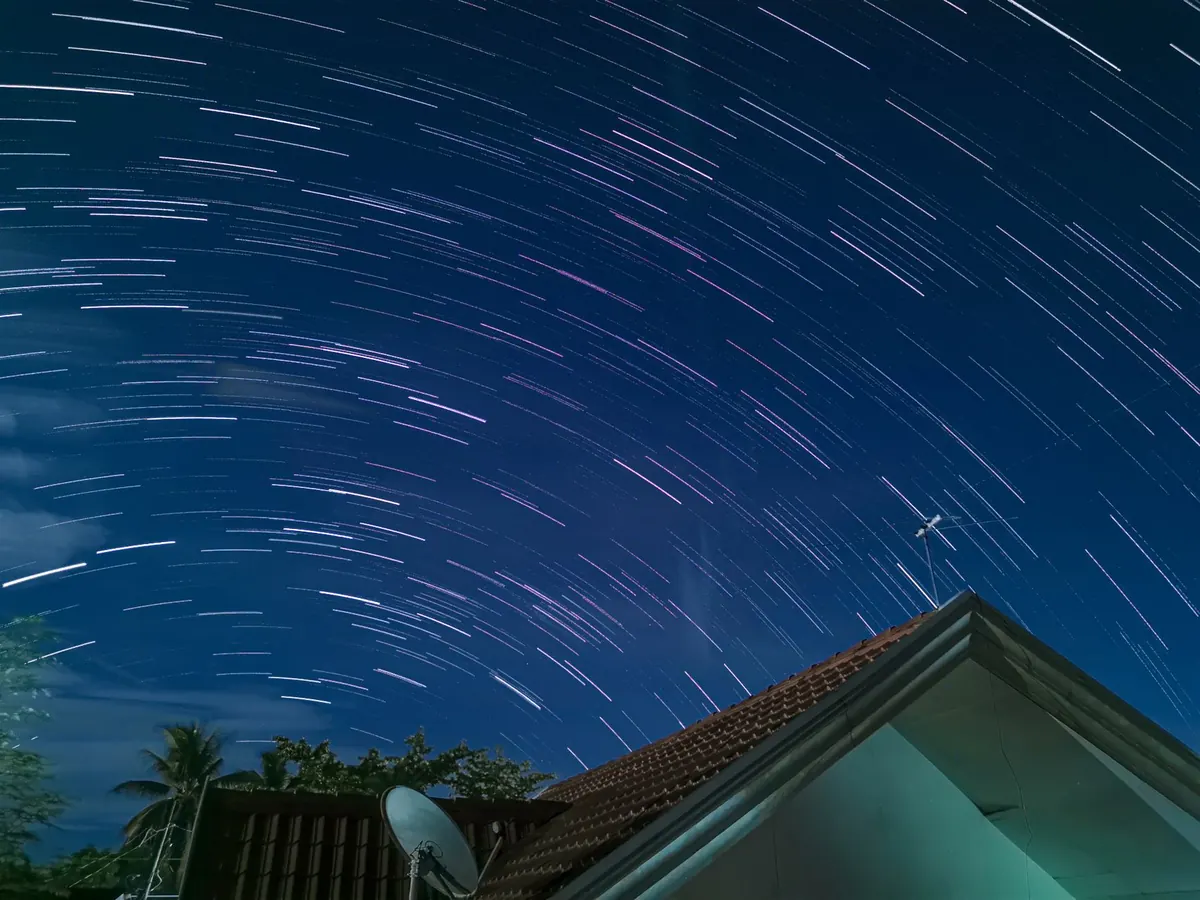
Photo: Kristel Escurzon / Pexels
You Might Also Like
A plain-English guide to astronomical units, light-years and parsecs, with everyday scale tricks that make the huge numbers behind space stories easy to picture.
A season-by-season packing guide for UK meteor shower nights, from Perseids in August to Geminids in December, covering layers, red torches and seating.