James Webb vs Hubble: Key Differences for Beginner Astronomers
Point Hubble and the James Webb Space Telescope at the same patch of sky and you will not get the same picture. Hubble shows a sharper, more familiar universe — the kind of image that has hung on classroom walls since the 1990s. JWST looks through dust, picks up heat from objects so cold they barely glow, and reaches back towards the first galaxies. Both are busy working observatories. The useful skill for a beginner is knowing which one answers the question you are actually asking.
Why wavelength comes first
Almost every other difference between the two telescopes follows from the light they were built to catch.
Hubble works mainly in visible light, with a genuinely useful extension into the near-ultraviolet and a smaller near-infrared capability. That range overlaps with what your eyes and most amateur telescopes can see, which is a large part of why Hubble images feel immediately readable.
JWST is an infrared telescope. Its instruments cover roughly 0.6 to 28 micrometres, a long way past red. Two things make that range valuable. The first is dust: cold grains in star-forming regions block and scatter visible light, but infrared slips past them, so JWST can watch stars being born inside clouds that look like empty silhouettes to Hubble. The second is redshift. Light from extremely distant galaxies has been stretched by the expansion of the universe on its journey to us, and by the time it arrives much of it sits in the infrared.
The trade-off is real. JWST cannot see visible or ultraviolet light at all. Anything that depends on ultraviolet — hot young stars, some quasars, Jupiter’s aurorae — remains Hubble’s work.
Orbit: low Earth versus a million and a half kilometres
Hubble orbits about 540 kilometres above your head, completing a circuit every 95 minutes or so. JWST sits near the second Sun–Earth Lagrange point, roughly 1.5 million kilometres out — about four times the distance to the Moon.
What Hubble’s orbit means
Earth blocks a large slice of sky at any moment, and the telescope passes through a region of weaker magnetic shielding over the South Atlantic that adds noise to observations. On the other hand, astronauts could reach it, and five servicing missions — the last in 2009 — repaired and upgraded instruments that were never meant to be touched. Since 2024 it has run on a reduced set of gyroscopes, which trims some pointing flexibility but keeps it observing.
What L2 means
Far from Earth’s heat and shadow, JWST can stare at one patch of sky for hours without the planet sliding through the field of view. It stays cold by hiding behind a sunshield the size of a tennis court; the telescope runs below about 50 kelvin, close to −223 °C, with the MIRI instrument’s detectors colder still. Nobody will ever service it. It also cannot point just anywhere: the sunshield must always face the Sun, so its available sky is a broad band that shifts with the seasons. Mercury is off limits, and Earth and the Moon are kept well away.
Mirror size, light grasp and sharpness
Hubble’s primary mirror is 2.4 metres across, a single polished piece of glass. JWST’s is 6.5 metres, built from eighteen hexagonal beryllium segments coated in gold, folded for launch and unfolded once in space.
The larger mirror collects roughly six times as much light. That is why JWST can record a faint object in a fraction of the exposure time Hubble would need, and why it can detect things Hubble simply cannot reach.
Sharpness is more subtle. The smallest detail a telescope can resolve depends on both wavelength and mirror diameter. Hubble works at short wavelengths with a small mirror; JWST works at long wavelengths with a big one. At two micrometres, JWST resolves features a little under a tenth of an arcsecond across — better infrared detail than anyone has had before. In plain visible light, though, Hubble still produces the crisper picture. Neither fact cancels the other out.
What each telescope does best
If you are choosing which one to follow for a particular interest, this is the short version.
- Hubble: visible-light portraits of planets, nebulae and galaxies; ultraviolet studies of hot stars and quasars; long-exposure deep fields where you want the familiar look of optical astronomy.
- JWST: the earliest galaxies; exoplanet atmospheres, read from the way starlight filters through them; stars forming inside dense dust; the debris discs around young stars; and cold objects such as brown dwarfs.
- Both: solar system targets, though JWST has to work around brightness limits and pointing restrictions when a planet like Jupiter is in view.
Reading the images without being misled
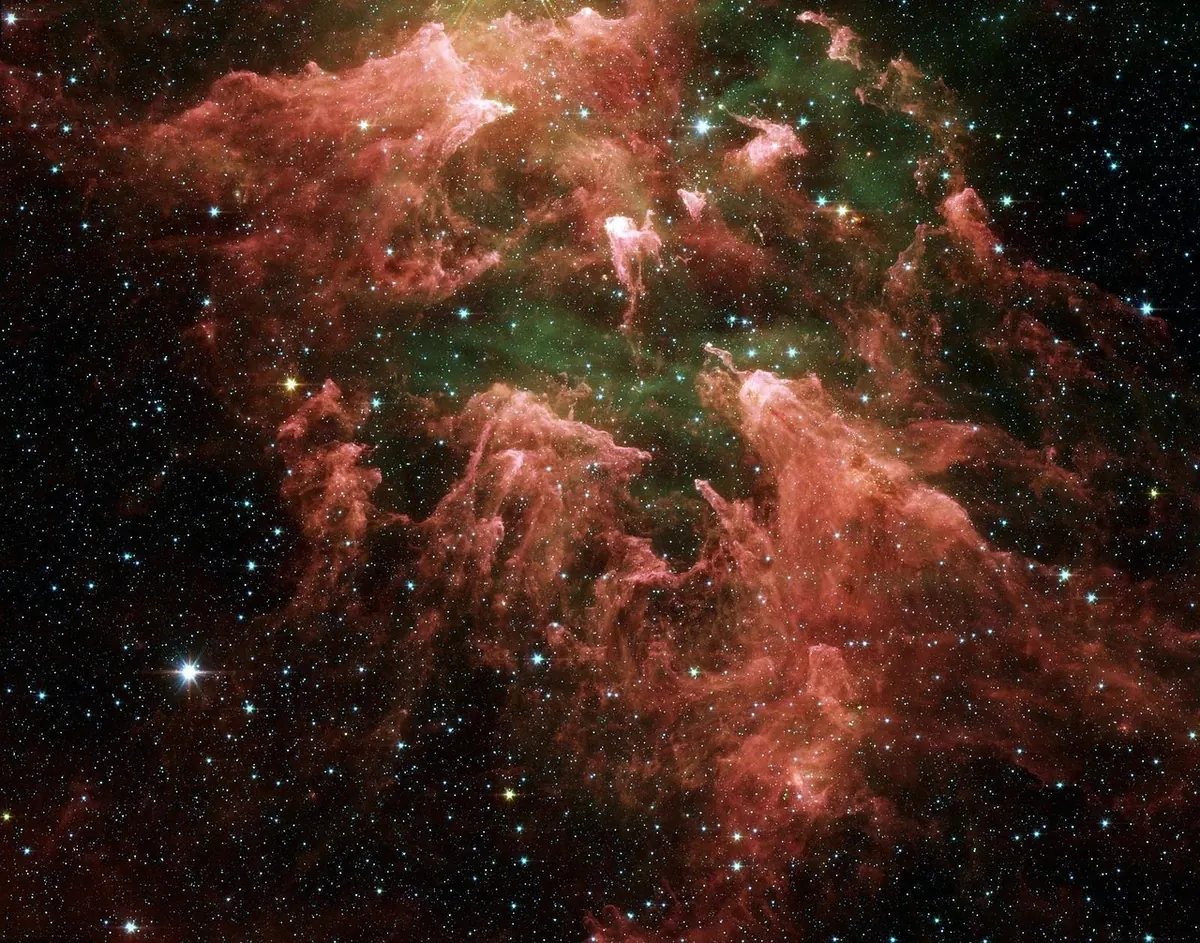
Infrared light is invisible, so the colours in a JWST image are assigned: different infrared wavelengths are mapped onto reds, greens and blues your eyes can process. Hubble images are closer to what a very sensitive eye might see, though they too are composites built from separate filters.
One easy way to tell the two apart is to count the spikes. Hubble’s secondary mirror is held by struts that create four points of light around bright stars. JWST’s hexagonal segments and support structure produce six main spikes, sometimes with fainter
Photo: WikiImages / Pixabay
You Might Also Like
A plain-English guide to astronomical units, light-years and parsecs, with everyday scale tricks that make the huge numbers behind space stories easy to picture.
A practical guide to telling the ISS, Starlink trains and sudden satellite flares apart using timing, direction, brightness and simple tracking tools.