How to See the International Space Station from Your UK Back Garden
It costs nothing, needs no equipment, and takes less time than making a cup of tea. The International Space Station sails over Britain most weeks, and on a good pass it outshines every star and planet above you, sometimes rivalling Venus. The only difficulty is timing. The station is visible for just a few minutes at a stretch, during a narrow window after dusk or before dawn, and then it is gone. Read a pass prediction correctly, step outside at the right moment, and you will watch a brilliant point of light cross the sky from horizon to horizon. Here is how to do it properly.
What You Are Actually Looking At
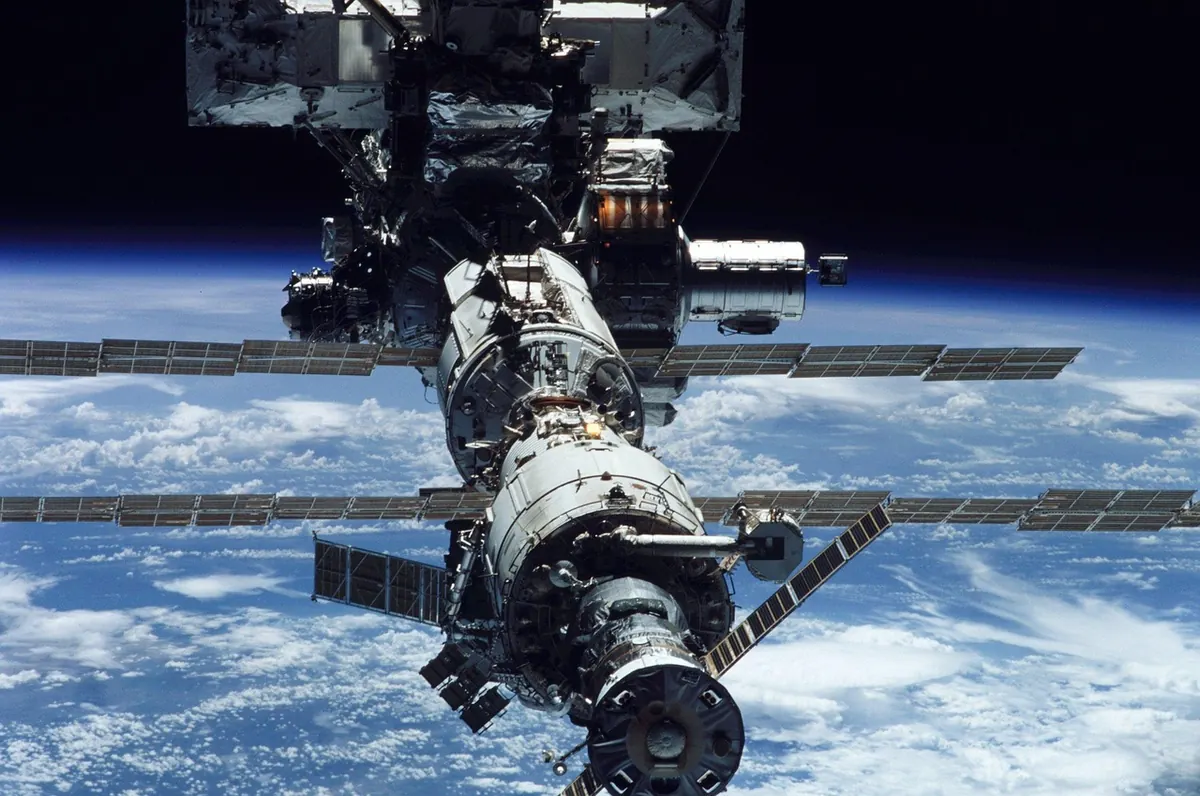
The station orbits roughly 400 kilometres above your head, travelling at about 28,000 kilometres an hour and completing a lap of the planet every 90 minutes or so. It carries no lights of its own. What you see is sunlight bouncing off its solar arrays and metal hull, which is why passes bunch together in the couple of hours after sunset and before sunrise — the station is still in daylight while your patch of ground has fallen into dusk, so it stands out against a darker sky.
In the middle of the night, that same station is usually invisible, because it has slipped into Earth's shadow and has nothing to reflect. This also explains the odd moment when a pass fades out halfway across the sky. It has not switched off or been switched off; it has simply entered the shadow and dropped out of view.
Step One: Find Out When It Passes Over Your Roof
Predictions are reliable to within a few seconds, so there is no need to guess. Pick whichever of these suits you:
- NASA's Spot the Station — sign up for email or text alerts for your nearest city; the alerts include direction and duration.
- Heavens-Above — the most detailed free option, with sky charts and brightness figures for every pass.
- N2YO — quick, straightforward pass lists you can set to a UK town.
- ISS Detector, Sky Guide, Star Walk or Stellarium Mobile — phone apps that push a reminder shortly before a good pass and point you in the right direction.
Treat an app's compass arrow as a rough guide rather than gospel. Phone magnetometers are easily confused by metal fences, phone cases and car keys. Waving the handset in a figure of eight usually recalibrates it, but it is worth checking against a known landmark before you rely on it.
Step Two: Read a Pass Prediction Properly
A prediction table looks like a wall of numbers at first. Four of them matter.
Direction and path
The listing tells you where the station will appear, roughly where it peaks, and where it disappears. A typical UK pass might read: appears in the west-south-west, reaches maximum altitude in the south, disappears in the east. Knowing all three means you can stand facing the right way instead of spinning on the spot.
Maximum elevation
This is how high it climbs, measured in degrees above the horizon, where 90 degrees is directly overhead. At arm's length, your clenched fist covers about 10 degrees. Low passes below 20 degrees are dim and easily lost behind rooftops and trees. Start with passes above 40 degrees; they are bright, slow and forgiving.
Duration
A really good pass lasts five or six minutes. Anything under two minutes is a brief flicker near the horizon and a poor first attempt.
Magnitude
This is a brightness scale where smaller and more negative numbers mean brighter, the same system astronomers use for stars. Minus three or better is outstanding. Minus one is still perfectly easy to see from a suburban garden.
Step Three: Get Outside and Find It
- Choose your spot. You want an open view, particularly in the direction the station first appears. A back garden with a low eastern fence beats a narrow street between tall houses.
- Go out two or three minutes early. Settle, look up, and let your eyes adjust. Ten minutes of darkness makes a real difference.
- Put the phone away. Even a dimmed screen wrecks your night vision. Check the time, then pocket it.
- Look for a moving dot. The station looks like a steady white point of light — like a star that has quietly detached itself and started drifting. It does not blink, flash or make a sound.
- Follow it with your eyes only. Binoculars make it harder, not easier. The whole point is the sweep across the sky, and a bright pass is obvious without any help.
- Do not panic if it fades. As above, that usually means Earth's shadow, not a fault in your technique.
Making the Most of UK Skies
Cloud is the main enemy, and it is worth checking a cloud-cover forecast rather than a general weather one. Clear spells of an hour or two are often enough.
Light pollution is less of a problem than people expect. Because the station can be brighter than anything else in the sky, even city dwellers see high passes quite comfortably. What does hurt is glare from nearby streetlights, so stand with your back to the lamp rather than staring across it. A torch with a red filter, or a red-tinted screen, will save your night vision if you need light.
Season matters too. In midwinter, evening passes arrive in properly dark skies and are beautifully clear. Around June and July, true darkness never really falls across the UK, so the best sightings happen in deep twilight shortly after sunset — the station can still be seen, often startlingly bright against a blue sky, but you need to know exactly where and when to look.
Viewing patterns also shift. A run of good evening passes lasts a few weeks, then the station moves into a spell of early-morning passes before returning to evenings. If the current times are inconvenient, wait a fortnight and check again.
Is That the ISS, or a Plane?
Aircraft give themselves away with blinking strobes, navigation lights in red and green, and a slow drift that eventually reveals a fuselage. The station is a single steady point of light with no flashing at all. Meteors are gone in a second or two and often leave a trail. Other satellites look similar but are usually much fainter, and a few brighten briefly before fading. If it is bright, silent, unhurried and unblinking, you have found the right thing.
Your Five-Minute Plan for Tonight
Check a tracker, look for a pass above 40 degrees lasting four minutes or more, note the direction it appears from, and set an alarm for two minutes before that time. Step outside, face the right way, let your eyes settle, and wait. Because the station laps the planet every 90 minutes, a single evening sometimes offers two or three visible passes — so once you have caught one, check whether another is due about an hour and a half later.
After the first successful sighting, the whole thing becomes second nature. You will start recognising the station by its pace and brightness alone, the way you recognise a familiar aircraft overhead. And it is worth pausing for a moment when you do: there are people up there, roughly 400 kilometres away, travelling at five miles a second, looking back down at the same patch of Britain you are standing in.
Photo: WikiImages / Pixabay

You Might Also Like
A plain-English guide to astronomical units, light-years and parsecs, with everyday scale tricks that make the huge numbers behind space stories easy to picture.
A practical guide to telling the ISS, Starlink trains and sudden satellite flares apart using timing, direction, brightness and simple tracking tools.